Why does the Asian hornet threaten honeybees?
The Asian hornet hunts bees by hovering in front of hives. Predation kills foragers and paralyses flight, weakening the colony before winter. French beekeeping puts the losses at around 98 million euros a year, with estimates ranging from 80 to 100 million.
Written by the Report Hornet teamEditorial method
How does predation unfold at a hive?
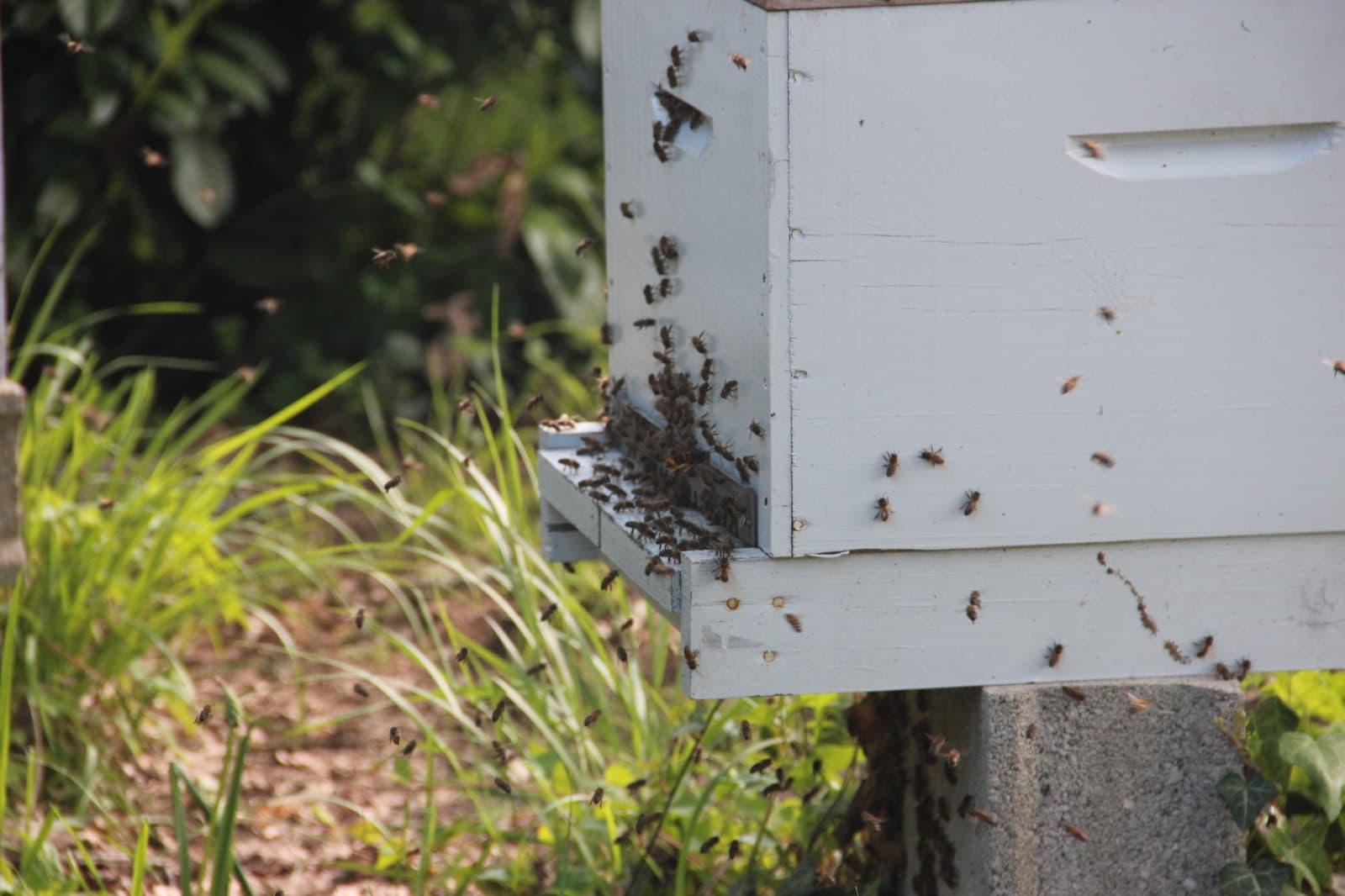
The hornet hovers one or two metres from the entrance and intercepts foragers on their way back, laden and therefore less agile. It carries the prey off, cuts it up and takes the thorax back to the nest to feed the larvae.
The heaviest effect is not the number of bees caught but the paralysis of flight. Under pressure the colony stops going out, builds no stores and enters winter weakened. That is how an apiary empties without any dramatic attack taking place.
Why is the European honeybee so defenceless?
Because it did not evolve alongside this predator. Asian honeybee species have a collective defence, smothering the hornet in a ball of workers that overheats it, which is absent or largely ineffective in Apis mellifera.
No natural predator exerts meaningful control over the Asian hornet in Europe, which explains how quickly it spread after its accidental introduction into south-west France in the early 2000s.
What does this predation cost beekeeping?
Available estimates put annual losses for French beekeeping between 80 and 100 million euros, with the profession citing a figure close to 98 million. The national control plan launched in March 2026 carries 3 million euros a year, a gap beekeeping organisations consider insufficient.
The law of 14 March 2025 created a compensation scheme for beekeepers' economic losses, tied to the mechanisms of the French rural code.
These figures come from industry estimates rather than an exhaustive survey. Cite them as an order of magnitude, not as a measurement.
How do you protect an apiary?
The measures that work act at the hive entrance or on nearby nests, not on the hornet population at large.
- Reduce hive entrances and fit muzzles, which disrupt the hornet's hovering.
- Keep colonies strong, since a weak colony is attacked first.
- Raise hives and clear the space in front of them, to limit hovering positions.
- Have nests found within foraging range destroyed, by far the most effective measure.
- Reserve trapping for apiaries already affected, using traps with calibrated exits.
Frequently asked questions
How many bees does one hornet catch per day?
A hunting hornet can take several dozen foragers a day, and several hornets take turns at the same hive. The decisive impact remains the halt in flights rather than the number of catches.
Does the Asian hornet attack other insects?
Yes. Its diet includes flies, wasps, butterflies and various wild pollinators. The honeybee is simply the most concentrated and predictable resource, and therefore the most exploited.
Can a colony recover from a season of predation?
Yes if it was strong and if the pressure stops before overwintering. A colony that could not build autumn stores rarely survives the winter, even without further attack.