How do you identify an Asian hornet?
The Asian hornet (Vespa velutina nigrithorax) measures 2 to 3 cm. Its thorax is entirely black, its dark abdomen carries one wide orange band on the fourth segment, and its leg tips are bright yellow. The European hornet is larger, with a yellow abdomen striped black and a reddish thorax.
Written by the Report Hornet teamEditorial method
What are the four signs that settle it?
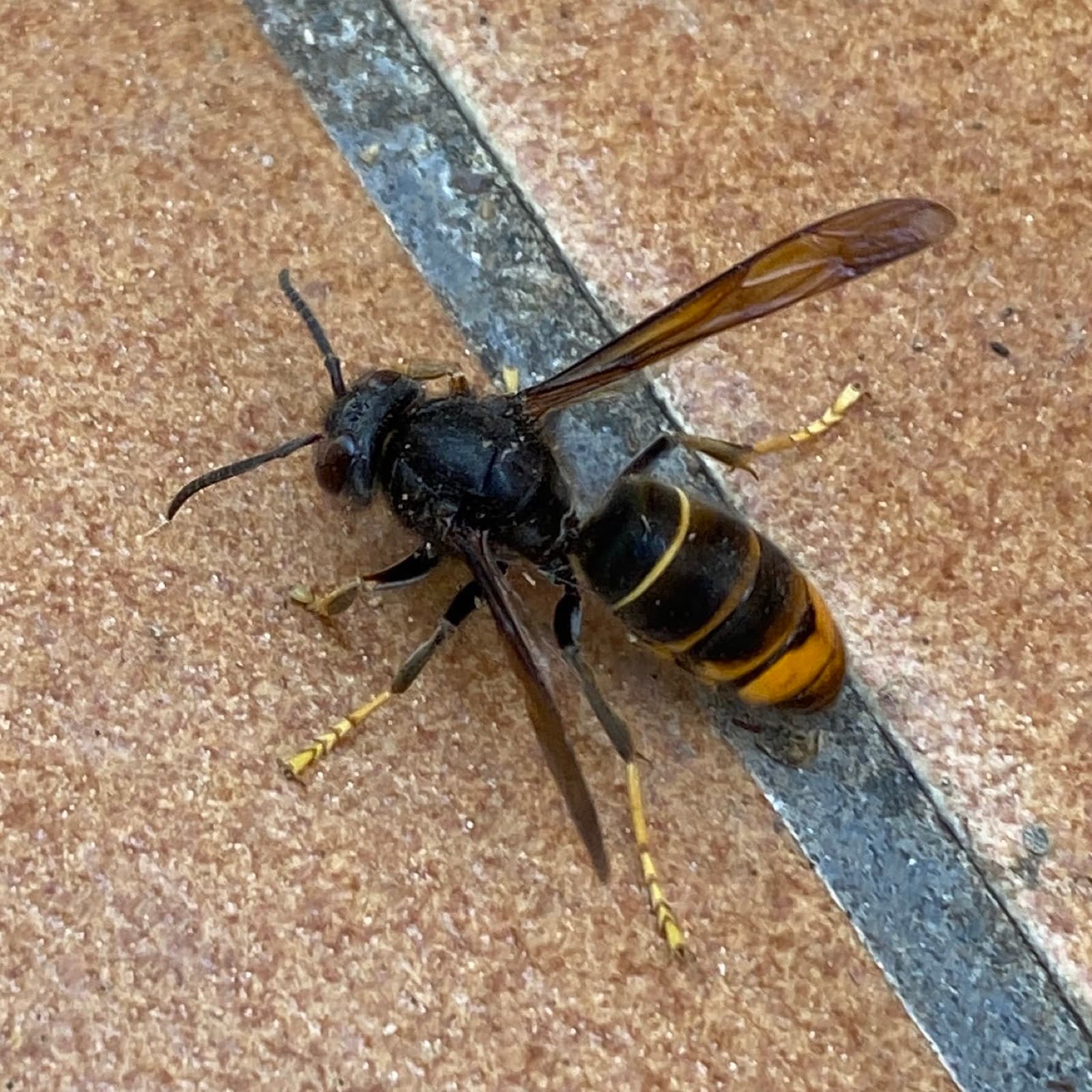
Four features are enough to identify an Asian hornet with confidence, and all of them can be read from a safe distance, without approaching the insect.
- The thorax is entirely black, with no reddish markings.
- The abdomen is dark, crossed by a single wide orange band towards its tip.
- The legs are black at the base and clearly yellow at the tips, which is why the species is officially called the yellow-legged hornet.
- The face is orange, while the top of the head stays black.
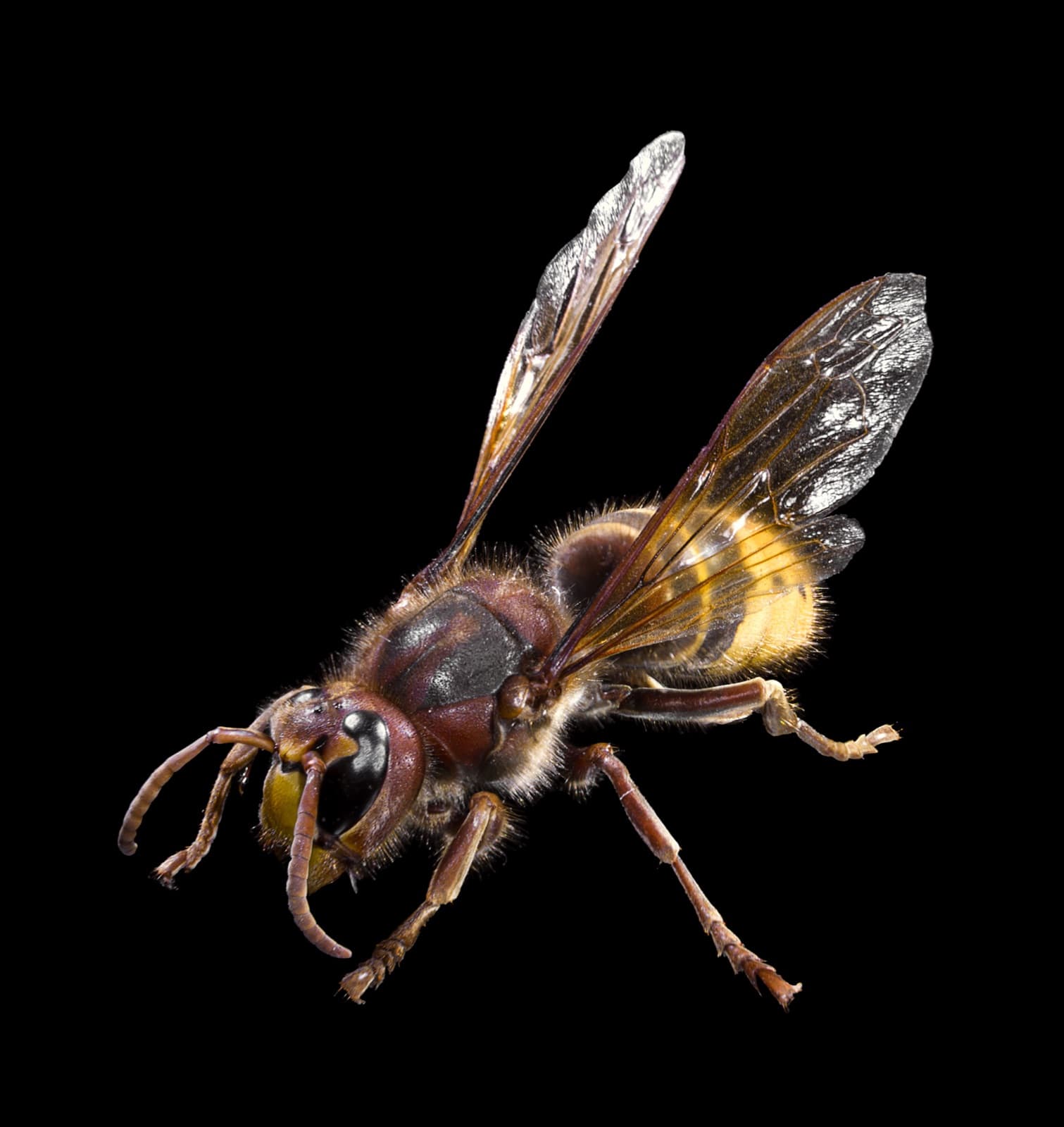
If the insect looks noticeably larger and its abdomen is mostly yellow, it is a European hornet, a native species protected in several regions, which should not be destroyed.
Asian hornet or European hornet: what differs?
The European hornet (Vespa crabro) is larger than the Asian hornet and much paler. The mistake almost always runs the same way: a European hornet taken for an Asian one, followed by an unnecessary destruction request.
| Feature | Asian hornet | European hornet |
|---|---|---|
| Size | 2 to 3 cm | 2.5 to 3.5 cm |
| Thorax | Plain black | Reddish and black |
| Abdomen | Dark, one wide orange band | Yellow striped black |
| Legs | Bright yellow tips | Reddish brown |
| Night activity | No | Yes, drawn to light |
What does an Asian hornet nest look like?
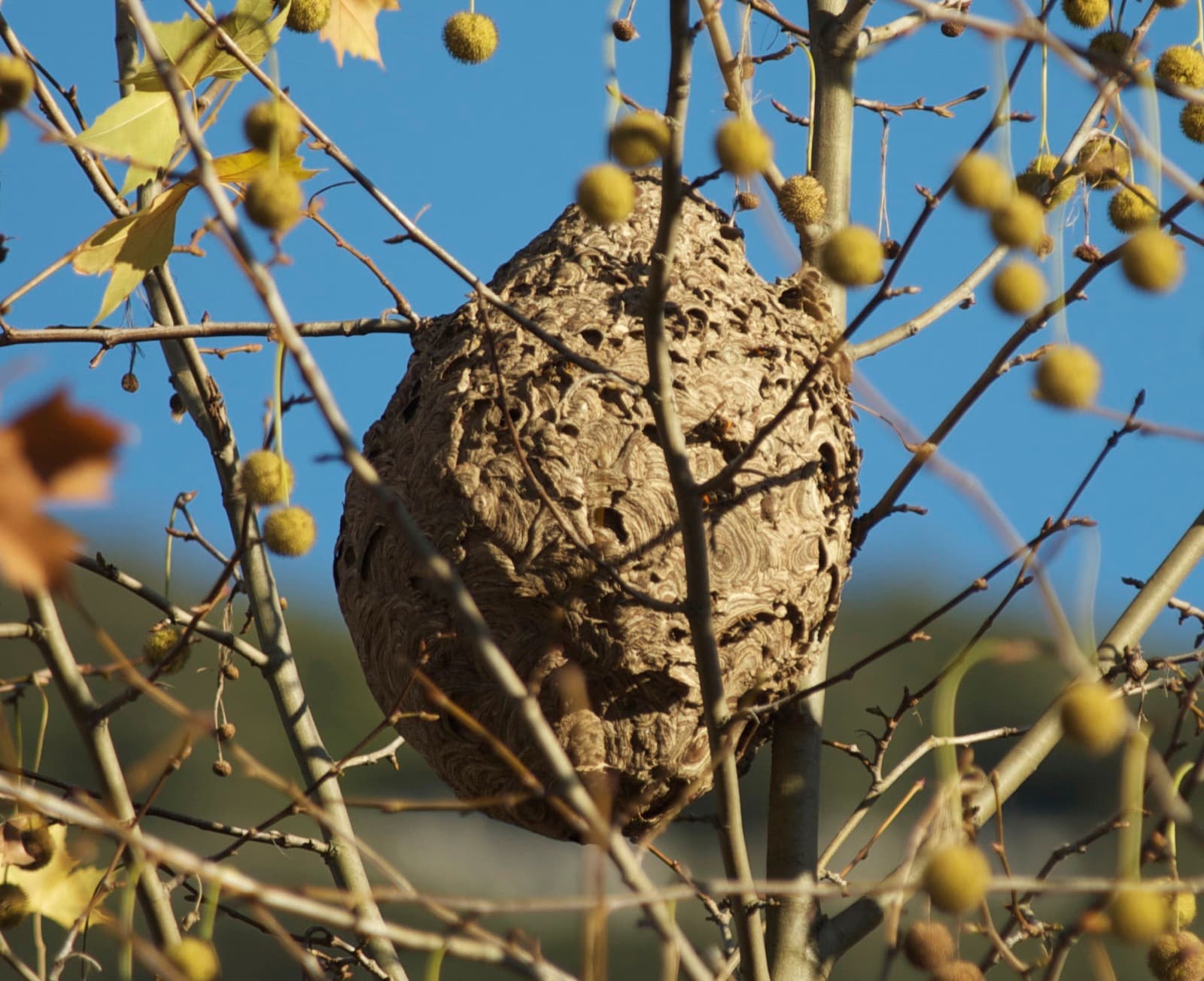
The nest is a sphere of grey or brown papier-mâché, visibly streaked, with a small opening on the side. That detail is the quickest way to tell it from a European hornet nest, which opens downwards.
In spring, a first nest the size of an orange appears in a sheltered spot, under an eave, in a garden shed or a hedge. In summer the colony often moves to a much larger secondary nest, frequently more than ten metres up in a tree, where it only becomes visible once the leaves fall.
What should you do once you are sure?
Report the sighting, then let a professional handle it. A geolocated report feeds the tracking of the species and requires neither an account nor paperwork.
Never try to confirm your identification by walking up to the nest. The colony defends several metres around its entrance and attacks as a group.
Frequently asked questions
Is the Asian hornet bigger than the European hornet?
No, it is smaller. The Asian hornet measures 2 to 3 cm, the European hornet 2.5 to 3.5 cm. The opposite belief is widespread and leads people to destroy nests of a native species that poses no threat to hives.
Does the Asian hornet fly at night?
No. The Asian hornet is active during daylight only. A large hornet bumping against a lit window in the evening is almost always a European hornet.
Are there insects that look like it?
Yes. The hornet mimic hoverfly and some large syrphids copy its colours without having a sting. One feature rules them out: these flies show a single pair of wings and very large eyes covering most of the head.